Father Raising a Daughter: In 22 Bestselling Puberty Books, a Mother Is Shown Smiling With Her Daughter in 16 of Them and a Father in Six
The thing that is actually different about a father raising a daughter is not that she needs a different kind of father. It is that the material written to prepare her for her own body is written as though he is not in the house. A 2025 content analysis of 22 bestselling puberty books for girls found a mother shown expressing positive emotion with her daughter in 16 of them and a father in six, and concluded that fathers were given no clear role in preparing their daughters for puberty.
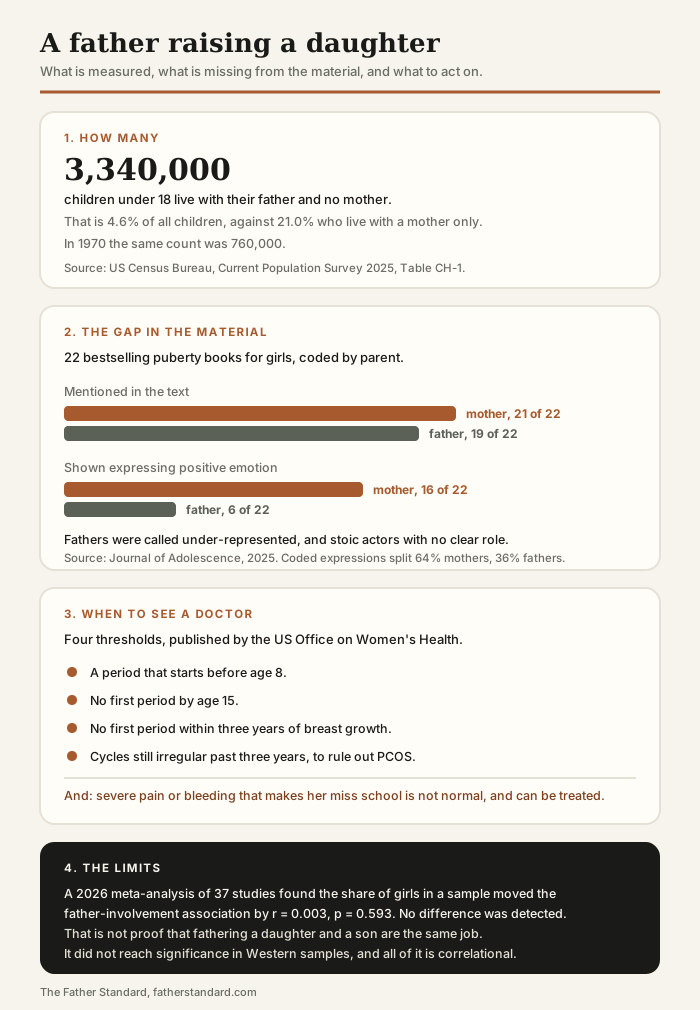
That gap has a population attached to it. In the 2025 Current Population Survey, 3,340,000 children under 18 lived with their father and no mother in the household. Nobody has written the guidance for them.
So this page does two things. It shows where the gap is, and then it goes around it, using the timings and the thresholds that the US Office on Women's Health publishes directly. The practical part starts about halfway down, and if you are here because something specific worried you, the four thresholds in the table are the part to read first.
How many fathers are actually doing this
The Census Bureau has counted children by who they live with every year since 1960. In the 2025 Current Population Survey, 72,734,000 children under 18 were counted. Of those, 3,340,000 lived with their father and no mother in the household. In 1970 the same count was 760,000 out of 70,213,000.
| Children under 18 by household, 2025 | Number | Share |
|---|---|---|
| Two parents | 51,202,000 | 70.4% |
| Mother only | 15,308,000 | 21.0% |
| Father only | 3,340,000 | 4.6% |
| No parent present | 2,885,000 | 4.0% |
Those shares are ours, computed from the Census counts. The Census table publishes the numbers, not the percentages.
Two readings are worth separating. The father-only count has grown more than four times over in 55 years, which is real, though the survey has revised how it identifies who a child lives with more than once across that span, so 1970 against 2025 is not a perfectly like-for-like measurement. And father-only is still the smaller side of single parenthood by a wide margin: about four and a half children live with a mother only for every one who lives with a father only.
The count does not break out daughters from sons, so nobody can tell you how many fathers are raising a daughter alone. Anything you read putting a figure on that is estimating. What the table does establish is that the situation is common enough to hold roughly three and a third million children, and rare enough that the guidance industry has not written for it.
What this page is not going to re-argue
There is a prior question, which is whether a daughter needs a categorically different kind of father than a son. On the best pooled evidence, no difference has been detected. A 2026 three-level meta-analysis of 37 studies and 249 effect sizes tested the proportion of girls in a sample as a moderator of the father-involvement effect and found it moved the association by r = 0.003 (95% CI -0.007 to 0.013, p = 0.593).
Read that as a null result and nothing more. No difference was detected, which is not the same as proving there is none, and the same dataset carries two caveats large enough to matter: in Western-culture samples specifically the association was r = 0.075 and did not reach significance, and it was statistically significant only where fathers rated their own involvement. All of it is correlational.
Two pages on this site already work through that evidence rather than summarizing it. Our page on raising a son sets it against the measured differences in how fathers actually treat sons and daughters, and signs of a bad father son relationship goes through the reporter effect in detail. Our page on raising a daughter reaches the same conclusion from a different body of work. This page takes that as settled and moves to the part none of them cover.
Where being her father really is different, and it is not emotional
Researchers publishing in the Journal of Adolescence in 2025 ran a content and thematic analysis of 22 books on girls' pubertal development, drawn from Amazon's bestselling list in Children's Health and Maturing. They coded every appearance, every mention in the text, every illustration and every emotional expression, by parent.
Fathers are not missing from the words. A mother is mentioned in the text of 21 of the 22 books and a father in 19. The gap opens everywhere else. Mothers appeared significantly more often than fathers, t(21) = 3.18, p = .004, and were mentioned more heavily within the text, t(21) = 6.62, p = .001, at an effect size of d = 1.44, which is large: even where a father is present, far fewer words are spent on him.
The widest gap is in the warm moments. The parental emotional expression ratio was 64% mothers and 36% fathers, and mothers were significantly more likely than fathers to be shown expressing a positive emotion, t(21) = 4.34, p < .001. In plain counts: a mother is shown smiling, cheering or otherwise expressing positive emotion in 16 of the 22 books. A father is shown that way in six.
The authors' own summary is the line worth carrying:
Fathers were under-represented and portrayed as relatively stoic actors with no clear role in preparing their daughters for puberty.
That is a finding about the books, not about you. The same analysis found that some of the books explicitly named a valuable role for fathers in advocating for their daughters and keeping communication open, so the picture is not uniformly bleak.
One of the coded books tells its reader that some fathers may not have much experience talking about girls' body changes, and that she may need to help her father understand. Another tells her that if she has bled a lot and her mother is home, she may want to call her mother to bring clean clothes. Read those as a daughter with no mother in the house and the problem is obvious. The book has quietly handed her a task and named someone who is not there to do it.
The repair is logistical rather than emotional. Put a spare pair of underwear, spare trousers and a sealable bag in her school bag and in her sports bag, before anything happens. Then name the adult she goes to if it happens away from home and cannot reach you: the school nurse, a specific teacher, a friend's mother. The book assumed someone would be standing there. Your job is to make sure someone is.
What a federal health source actually tells you to act on
The practical answer to a book that writes you out is to go around it. The Office on Women's Health at the US Department of Health and Human Services publishes the same material without the illustrations, and much of it is decisions rather than feelings.
On timing, its menstrual cycle page states that the average age for a girl in the United States to get her first period is 12, that a girl may start anytime between 8 and 15, and that the first period normally arrives about two years after breasts first start to develop and pubic hair begins to grow. It also notes that the age at which her mother started can help predict when she will.
On what is normal afterwards, it states that for a few years after a first period, cycles longer than 38 days are common, and that girls usually get more regular cycles within three years of starting.
Then there are the four lines worth more than everything else on this page, because each one converts a worry into a specific action.
| What you notice | What the source says to do |
|---|---|
| Period starts before age 8 | See a doctor |
| No first period by age 15 | See a doctor |
| No first period within 3 years of breast growth | See a doctor |
| Cycles still irregular past 3 years in | See a doctor, to rule out PCOS |
PCOS is polycystic ovary syndrome, a hormone condition. It is named here because the source names it, not because you are meant to assess it yourself. The action is the same either way.
And one more, stated plainly on the same page: severe pain or bleeding that causes her to miss regular activities is not normal and can be treated. A father who has decided not to pry is exactly the parent who will let that go unaddressed for years, because he never hears about it and she assumes it is what everybody has.
What this changes about an ordinary week
Very little of it is emotional labour, which is the point.
Put her first period on the calendar when it happens, in a note only you can see, and keep a rough count for the first three years. You are not tracking her. You are holding the one piece of information that decides whether the phrase "cycles still irregular past three years" applies to her, and she will not be counting.
Ask once a term, in a flat voice, whether she has ever missed school or training because of period pain. That single question is the whole of the screening. It is not a conversation about her body, it is the same question you would ask about a knee. If the answer is ever yes, that is the trigger for a doctor's appointment, not something to watch for another term.
Buy the supplies before they are needed and put them where she can reach them without asking anyone. The most common failure in a father-only house is not squeamishness, it is a supply chain that requires a request.
If she has an aunt, a grandmother, a coach or a family friend she trusts, tell her plainly that person is available and that using them is not a betrayal of you. The books repeatedly name a female adult as the natural confidante, and nothing in the involvement research speaks to whether a father is a substitute for having somebody she can ask. Arranging that is a father's job, not a father's defeat. The same logic runs in reverse in our piece on raising a son as a single mom.
When this is heavier than parenting advice
If you are raising her alone after a death, a departure or an estrangement, the checklist above is not the whole problem, and it would be dishonest to present it as though it were. Grief and sole responsibility interact, and the parts of this that feel impossible are usually not the logistics.
Nothing on this page is medical or psychological advice, and none of it substitutes for a licensed professional who can see your actual situation. If you or she are in crisis in the United States, the 988 Suicide and Crisis Lifeline is reachable by call or text at 988, or at 988lifeline.org. If the difficulty is a relationship that has already broken rather than an emergency, our page on the father-daughter relationship covers what reconnection looks like at different ages.
Father raising a daughter in one picture
Test yourself
Key takeaways
Last reviewed by The Father Standard Editorial Team on September 21, 2026. How we source our work and use AI is documented on our editorial standards page.
FAQ
What should a father raising a daughter actually prepare before puberty starts?
Three things, and none of them are conversations. A spare change of clothes and a sealable bag in her school bag and sports bag. A named adult at school she can go to if it happens away from home. And supplies kept somewhere she can reach without asking anyone. The most common failure in a father-only house is a supply chain that requires a request.
When should a father take his daughter to a doctor about her periods?
Five triggers, four of them stated directly by the Office on Women's Health: a period starting before age 8, no first period by age 15, no first period within three years of breast growth, and cycles still irregular more than three years after they started. The fifth is on the same page and is the one most likely to go unreported in a father-only house: severe pain or bleeding that makes her miss school or activities is not normal and can be treated.
At what age should I expect my daughter's first period?
The US Office on Women's Health gives an average of 12 in the United States, with a normal range of 8 to 15, arriving about two years after breasts first start to develop. The most useful predictor you have is not the average: it is the age her own mother started, which means it is worth asking that question of whoever can answer it, while they can.
Are fathers really left out of the books written for girls about puberty?
They are present in the words and absent from the warmth. In the 22 bestselling titles analyzed in the Journal of Adolescence in 2025, a father is mentioned in the text of 19 of them, so this is not simple erasure. But a father is shown expressing positive emotion in six books against 16 for mothers, and the authors described fathers as under-represented and portrayed as relatively stoic actors with no clear role.
How many children in the United States live with only their father?
3,340,000 children under 18, in the 2025 Current Population Survey. For scale, that is roughly one child living with a father only for every four and a half living with a mother only, and more than four times the 760,000 counted in 1970. The Census does not publish a daughters-only breakdown, so the number of fathers raising a daughter alone is not a figure anyone can give you.
Does a daughter need a different kind of father than a son does?
No difference has been detected. A 2026 meta-analysis of 37 studies and 249 effect sizes moved the father-involvement association by r = 0.003 (p = 0.593) when testing the share of girls in a sample. That is an absence of a detected difference, not proof the two jobs are identical, and it comes with real limits: the association did not reach significance in Western-culture samples, and held only where fathers rated themselves.
Should I find a woman to talk to my daughter about her body?
Arranging a trusted female adult she can go to is worth doing, and it is not an admission that you cannot parent her. What matters is that she is named before she is needed, and that your daughter knows you arranged it deliberately rather than handed her off. The practical test is whether she could tell you, today, who that person is.
Sources
- Census Bureau has counted children by who they live with (census.gov)
- 2026 three-level meta-analysis (europepmc.org)
- Journal of Adolescence (europepmc.org)
- its menstrual cycle page (womenshealth.gov)
- 988lifeline.org (988lifeline.org)