The Distant Father: How Good Men End Up Strangers at Home, and How It Reverses
Nobody plans to become a distant father. There is no morning where a man decides his kids will feel like polite strangers by the time they are fifteen. It happens the way most expensive things happen: quietly, in increments too small to trigger an alarm.
This article is about the mechanism. Not the guilt, the mechanism. Because once you can see how the distance is built, you can see exactly where it unbuilds.
The math nobody runs
Start with the numbers, because they are more brutal than the feelings.
American fathers spend, on average, about one hour a day caring for and helping their kids, according to Pew Research Center's analysis of the American Time Use Survey. That is the average across all fathers. For a man running a company or a team, with travel weeks and deal weeks and quarters that end badly, the real number is often lower and it arrives at the end of the day, when he has the least of himself left to give.
Here is the part that should stop you. The window is not open forever. Analysis of American time-use data shows that the daily hours a parent spends with his children peak in his late thirties and then fall by roughly half by his early fifties. By the time a man clears his runway at fifty, the daily overlap he was counting on has mostly already happened. Or it has not.
The distance is not built by one dramatic failure. It is built by a thousand ordinary evenings where you were present in body and unreachable in practice.
The pattern: how high performers drift
The men this happens to are not careless men. They are usually the opposite: conscientious, responsible, carrying more than anyone around them knows. The drift has a recognizable shape.
Stage one: the trade feels temporary
Early on, the deal seems fair. You take the promotion, the travel, the fund raise, the second location. The family gets security, the house, the schools. You tell yourself the intensity is a phase. Almost every man in this pattern remembers saying the words "when things calm down."
Things do not calm down. Success does not reduce demands on a capable man. It compounds them.
Stage two: home becomes the recovery room
A man who spends all day making decisions comes home with nothing left for the hardest audience in his life. So home quietly changes function. It stops being a place where he participates and becomes a place where he recovers. He is there, on the couch, at the table, at the recital. But the part of him that asks real questions and hears real answers is still at the office.
Kids read this with terrifying accuracy. They do not have the vocabulary for it, so they draw the simplest conclusion available: he is not interested.
Stage three: the child stops offering
This is the stage most men miss, because it looks like peace. The eight year old who used to narrate his entire day starts answering in single words. The daughter who used to climb on you now says goodnight from the doorway. The offers stop coming because offers that go nowhere are expensive for a child to keep making. With a daughter, that same withdrawal takes its own shape at each age, which we map in the father-daughter relationship guide. With a son the quiet arrives the same way and comes back the same way, which is the whole subject of why the father and son relationship goes quiet and how it returns.
A quarter of American children lived apart from their fathers, a share that more than doubled between 1960 and 2010. But physical distance is only the visible end of the spectrum. The invisible version, living in the same house as a stranger, does not show up in any census. Where that distance follows a separation, protecting the bond becomes its own discipline: a father's standard for co-parenting after a split is about shielding the child from the conflict rather than winning it.
Stage four: both sides call it normal
By the teenage years the household has a working script. Conversations run on logistics: rides, grades, money, plans. Everyone is civil. Nothing is shared. If you ask the father, he will say things are fine, teenagers are just like that. If you ask the teenager, and someone eventually will, the answer is some version of: my dad is a good guy, I just do not really know him.
That sentence is the whole disease in one line.
Why the standard advice fails
Most advice aimed at this problem fails because it prescribes intensity where the wound is consistency.
The distant father, once he notices the distance, reaches for the tools that work at the office: the grand gesture, the big trip, the scheduled talk. He plans a week in the mountains to fix in seven days what drifted for seven years. The trip is usually fine. It is also usually a bubble. Everyone returns and the script resumes, because a script is not broken by an exception. It is broken by a new script.
What actually moves the needle is almost embarrassingly small. Pediatric guidance on talking with teens backs the underlying instinct even if it does not use these words: listen without judgment and skip the lecture. In practice that means frequent, low-stakes exchanges beat rare high-stakes ones. Availability beats interrogation, and timing beats duration.
And if you need a reason to take the project seriously that speaks the language of outcomes, take the longest study ever run on human flourishing. The Harvard Study of Adult Development has followed men for over eight decades, and its directors summarize the finding in one sentence: good relationships are the strongest predictor of long-term health and happiness that the study has found. Not career. Not net worth. The relationships. You are not fixing a soft problem. You are managing the highest-yield asset you own.
The reversal playbook
What follows is the practical part. It is deliberately small. If it looks beneath a man who runs real things, that is the point: the entry price of this project is ego, not time.
1. Take the first thirty days off the scoreboard
For one month, you are not trying to get anything back. No expecting warmth, no measuring responses, no "we need to talk." A child who has watched you be unreachable for years will treat sudden attention as weather: it will pass. Your first job is to be wrong about that, quietly, for thirty days.
2. Pick one recurring slot and defend it like revenue
Not family time in general. One specific, recurring, boring slot. The Thursday drive to practice. Saturday breakfast. The ten minutes after the dog gets walked. Recurring beats special, because the goal is to become part of the child's expected week again. You defend that slot exactly the way you defend a board meeting, meaning it does not move because someone senior wants it.
If you want the fuller system for finding that time inside a loaded calendar, that is its own playbook: Present, not just providing: a working father's playbook for time that counts.
3. Change the question format
Interrogation is the distant father's native tongue: how was school, how was the game, did you finish it. These are status-update requests, and kids answer them like status updates. One word.
Replace them with sideways openers. "What was the dumbest thing that happened today." "Settle something for me, is that teacher actually strict or just old." Specific, low-stakes, answerable without self-disclosure. You are not mining for feelings. You are re-establishing that talking to you is cheap and safe. Feelings ride in later, on rails built from nonsense.
4. Use parallel activity, not eye contact
The face-to-face sit-down is the most threatening format you can offer a disconnected kid, which is why the car, the kitchen, the garage and the walk exist. Shoulder to shoulder, hands busy, zero pressure. Some of the truest things your kids will ever say to you come out sideways, mid-drive, aimed at the dashboard instead of your face.
This works on teenagers in particular, and they are their own subject: how to reconnect with your teenage son covers the age where the door looks most closed.
5. Repair out loud when you miss
You will miss slots. A quarter will close badly, a flight will cancel. What kills the project is not the miss, it is the silent miss, because silence is the old script. The repair is one sentence, delivered straight: "I said Thursday was ours and I gave it away. That was wrong, and it is back on."
You are modeling the exact skill you want them to have at forty. Few things teach a child more than watching a powerful man correct himself without collapsing or making excuses.
6. Let the lag be the lag
You are roughly one to two seasons behind the relationship you want, sometimes more. The child warms up on their schedule, not yours. High performers hate this because effort is supposed to move numbers. Here, effort moves probability, quietly, and then one Tuesday the kid just starts talking and you realize the account has been compounding the whole time.
Here is the whole playbook in one view.
| Move | What it replaces | What it costs |
|---|---|---|
| Scoreboard off for 30 days | Expecting instant warmth back | Ego |
| One defended weekly slot | Vague "family time" | One protected hour |
| Sideways openers | Interrogation questions | Nothing |
| Parallel activity | The face-to-face big talk | Nothing |
| Repair out loud | Silent misses | One sentence |
| Let the lag be the lag | Daily scorekeeping | Patience |
What this looks like at ninety days
Not a movie ending. What you get at ninety days, if you hold the slots and keep the questions cheap, is smaller and better: the kid initiates once. A text, a joke, an unprompted sentence at the table. That is the signal that the offers have started again, the same offers that stopped in stage three.
From there it is maintenance, and maintenance is a thing you are already elite at. You built a career on showing up when it counted, on keeping promises to people who relied on you. Nobody at work doubts your word. The project is simply to make the people at home stop doubting it either.
The distance took years to build and it was built by a system. The reversal is also a system. Smaller, cheaper, and it pays in the only currency you cannot raise more of.
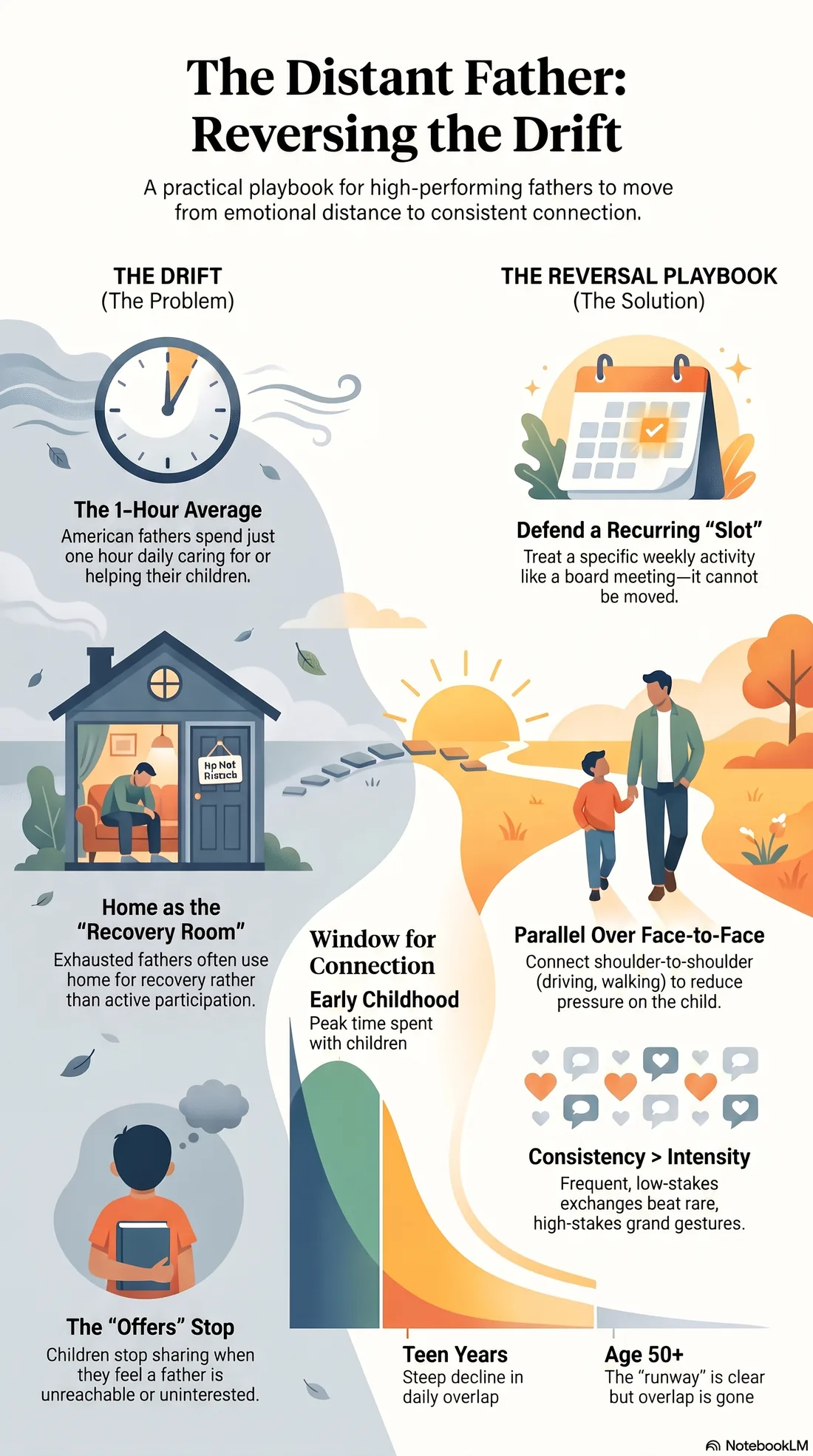
The whole mechanism, in one picture
One picture of everything above: how the drift builds, why the usual advice fails, and the phases of the reversal.
Test yourself
Five questions on the mechanism. If you can answer these, you understand the drift better than most men living inside it.
Key takeaways
Last reviewed by The Father Standard Editorial Team on July 28, 2026. Our sourcing and AI-use rules are public on the editorial standards page.
FAQ
What is a distant father?
A distant father is a man who is present in body and unreachable in practice. He is at the table, on the couch, at the recital, and the part of him that asks real questions and hears real answers is still at the office. Nobody plans it. The distance is not built by one dramatic failure, it is built by a thousand ordinary evenings, and it follows a recognizable four-stage shape: the trade that feels temporary, home turning into the recovery room, the child quietly stopping offering, and both sides eventually calling it normal. Physical absence is only the visible end of the spectrum, and the in-house version does not show up in any census. Because it is a pattern with a mechanism rather than a character flaw, it reverses.
Is it ever too late to fix the relationship with your kids?
Later is harder, but the mechanism works at every age because it is built on consistency, not access. With adult children the slots become calls and visits instead of drives and breakfasts, and the lag is longer. The step that does not change is the first one: consistent, low-pressure contact with the scoreboard turned off.
How long does it take to reconnect with a distant child?
There is no clinical timetable for this, so treat these as editorial working estimates, not measured research: expect the first unprompted signal in one to three months of consistent presence, and something that feels like a changed relationship in six to eighteen. The single biggest predictor is whether your recurring slot survives your busiest month, because that is the month that tells the child whether this is real.
What if my child wants nothing to do with me?
Refusal usually means the trust account is deeply overdrawn, so stop making withdrawals. Keep showing up in forms that require nothing from them: the ride, the fixed breakfast, the short message that asks no question. If there is real rupture behind the refusal, name it once, plainly, without defending yourself. Persistence without pressure is the only move that reads as sincere. And know the limits of a playbook: if the estrangement involves abuse, addiction, or a mental health crisis, bring in a licensed family therapist. In a crisis in the United States, call or text 988.
Sources
- according to Pew Research Center's analysis of the American Time Use Survey (pewresearch.org)
- peak in his late thirties and then fall by roughly half by his early fifties (ourworldindata.org)
- a share that more than doubled between 1960 and 2010 (pewresearch.org)
- listen without judgment and skip the lecture (healthychildren.org)
- good relationships are the strongest predictor of long-term health and happiness (adultdevelopmentstudy.org)